
About this course
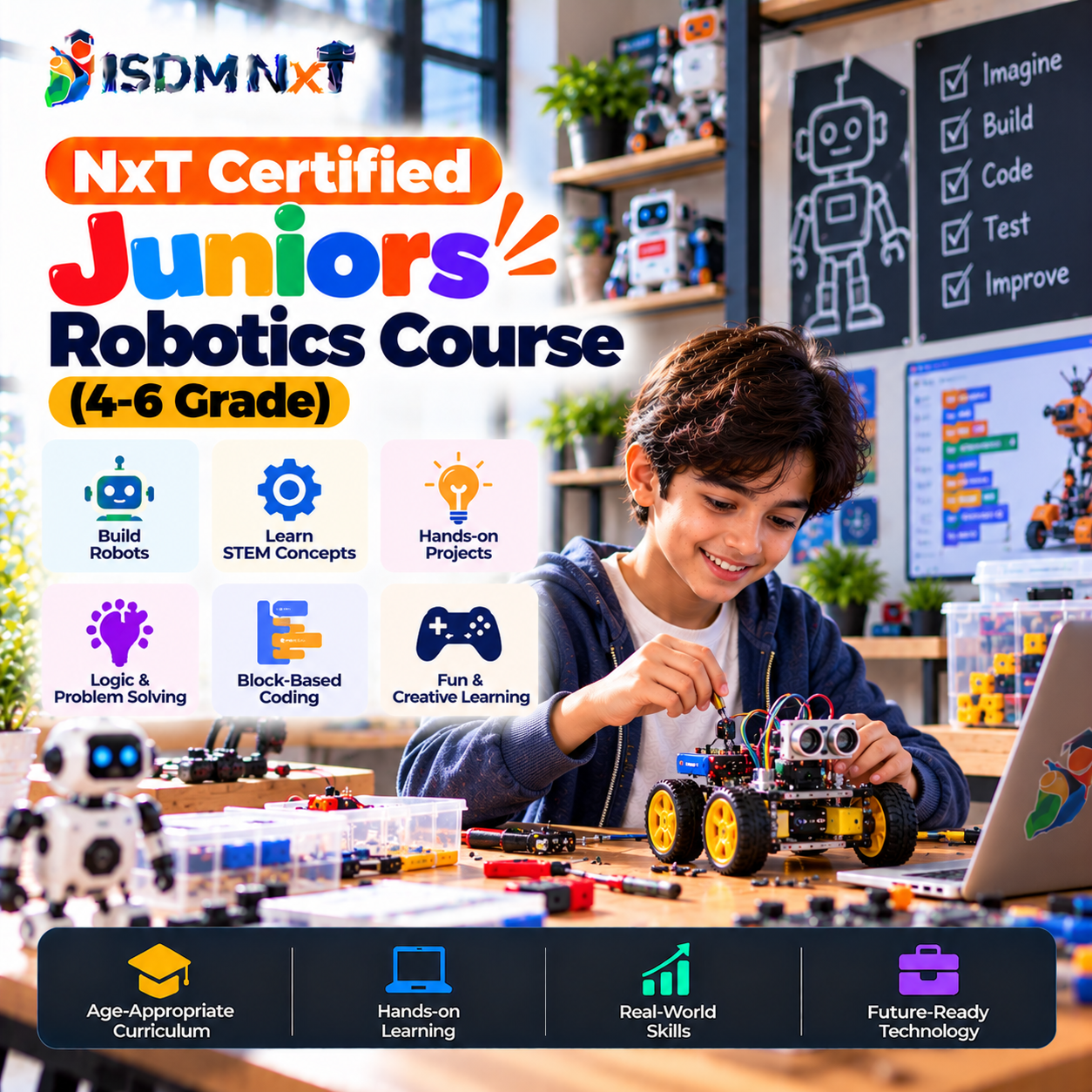
Welcome to the NxT Certified Juniors Robotics Course designed specifically for students in grades 4 to 6! This engaging course offers young learners the opportunity to explore the exciting world of robotics through hands-on projects and interactive learning.
Over the span of 3 months, students will:
- Learn the basics of robotics and programming.
- Engage in team-based projects to build and program robots.
- Develop critical thinking and problem-solving skills.
- Participate in fun challenges that foster creativity and innovation.
Tools you will master
Hands-on practice on the same software that companies use every day.
 Scratch
 Arduino
 Tinkercad
 Google GeminiAI
 NotebookLMAI
 Canva AIAI
What you will study, module by module
- Robotics Fundamentals And Applications
- Mechanical Components And Motion
- Electrical Components And Sensors
- Mechanical-Electrical Integration
- Robot Types And Applications
- Motors, Sensors, Processors, And Power
- Robotics Safety, Tools, And Testing
- Researching Real-World Robots
- Programming Logic And Algorithms
- Flowcharts And Algorithm Design
- Block-Based Coding Fundamentals
- Scratch Programming Basics
- LEGO Mindstorms Robotics
- Robot Movement And Control
- Loops And Conditional Statements
- Robot Navigation And Obstacle Avoidance
- Sensor Types And Operation
- Obstacle Detection And Sensor Fusion
- Sensors In Automated Applications
- Future Trends In Robotics
- Environmental Interaction And Sensing
- Programming Sensor-Based Responses
- Autonomous Vehicle Sensor Design
- Turning Commands and Speed Control
- Sensor-Based Path Following
- AI Decision-Making Processes
- Pattern Recognition in Robotics
- Self-Driving Cars and Automation
- AI Assistants and Robotics Applications
- Benefits and Challenges of AI Robotics
- Engineering Design Process
- Multitasking Robot Design
- Sensor Integration And Programming
- Robotics For Environmental, Medical, And Industrial Problems
- Robotics Challenges And Future
- Troubleshooting And Debugging
- Robot Invention Blueprinting
- AI And Machine Learning In Robotics
- Robot Components And Decision-Making
- IoT-Connected Smart Robotics
- Smart Robotics Applications And Challenges
- AI Assistants And Humanoid Robots
- Robotics In Space Exploration
- AI Basics And Prompting
- Using AI For Study Practice
- NotebookLM And AI Tutor Sessions
- AI-Assisted Presentations With Canva
- Scratch Coding With AI Ideas
- Training Models With Teachable Machine
- Safe, Honest And Responsible AI Use
After this course you will be able to
- Understand the fundamental concepts of robotics.
- Gain experience in programming robotic systems.
- Develop teamwork and collaboration skills.
- Enhance problem-solving abilities through practical challenges.
Projects you will build
Build a simple robot using a robotics kit.
Program the robot to complete a specific task.
Participate in a robotics competition with peers.
Create a presentation on the robotics project.
Jobs you can get after this course
Salary ranges are approximate for freshers in India and depend on city, company and your skills.
Who hires for these skills
Earn on your own
- Creating custom robots for clients
- Offering coding workshops for kids
- Developing educational content
- Building prototypes for startups
Is this course for you?
Best for
- Students in grades 4 to 6
- Parents wanting to enhance skills
- Young tech enthusiasts
- Future engineers and innovators
Eligibility
Students in grades 4 to 6.
What you get with ISDM NxT
Upon successful completion, students receive an ISDM NxT certificate, showcasing their skills in robotics.
How we help you get a job
- 1
Personalized resume building
- 2
Mock interview sessions
- 3
Access to job offers
- 4
Guidance on job applications
Your certificate & marksheet
After passing the final exam you receive an ISDM NxT certificate and marksheet like these. Tap to view.
Sample only - the real certificate carries your name, photo, marks, enrolment number and a QR code for online verification.
What next after this course
Questions students ask
Students will be provided with all necessary materials, including robotics kits and programming software.
No prior experience is necessary; the course is designed for beginners.
Yes, students will be assessed through project presentations and practical challenges.
The class size is limited to ensure personalized attention, typically around 15-20 students.